Medieval Masterpiece: A Tale of Ravenna

Walking through quiet, empty streets in Trastevere at five o’clock on a Saturday morning was never something I desperately wanted to do, but now I can say that I’ve done it.

My friends, Hannah, Emmie and I meandered through the narrow streets toward Rome’s train station with no breakfast and very little sleep. Today adventure awaits. We had planned a quick daytrip to a small-town East of Bologna, called Ravenna. Nestled just an hour from the coast, in the province of Emilia-Romagna, this town of almost 160,000 people is best known for its art – namely its extensive mosaics – and its long history. The city was once the capital of the Western Roman Empire from 402 until its collapse in 476 AD. Today, Ravenna is a world heritage site for its famous early Christian monuments.

After our nearly four-hour train ride through the mountains and countryside from Rome to Ravenna, we finally made it! The moment you exit the train station in Ravenna, it’s easy to pick up on the quiet, small town feel of this city. It doesn’t feel crowded when compared to Rome which gives you a nice break from any hustle and bustle. As a bonus, the city is about a fifteen-minute car ride from the coast which is said to have excellent beaches and resorts. Unfortunately, we didn’t get to go there, on this trip. Instead, our group stopped at a friendly and cozy café for a light breakfast, then we headed off to the first attraction – the Basilica of San Vitale. Built in 547 CE, the Basilica is considered one of the most important examples of early Christian Byzantine art and architecture in Europe, and it is also one of the eight structures in Ravenna listed as a UNESCO World Heritage site.

When you first enter the building, you’re immediately swept up by the width and towering height of the space, the beautiful mosaics and the stunning baroque fresco on the dome overhead. But the most famous aspect of the Basilica is, without a doubt, the apse. Made from magnificent Byzantine mosaics of gold and green, the Twelve Apostles and two other saints – who are probably Gervasius and Protasius, sons of St. Vitalus – decorate the tall arch. Beyond that, the apse mosaic depicts Christ the Redeemer sitting on the sphere of the world, flanked by San Vitale who is being handed a martyr’s crown, two angels, and Bishop Ecclesius, who founded the church.

The Basilica of San Vitale is a site to behold and a must-see attraction when in Ravenna.

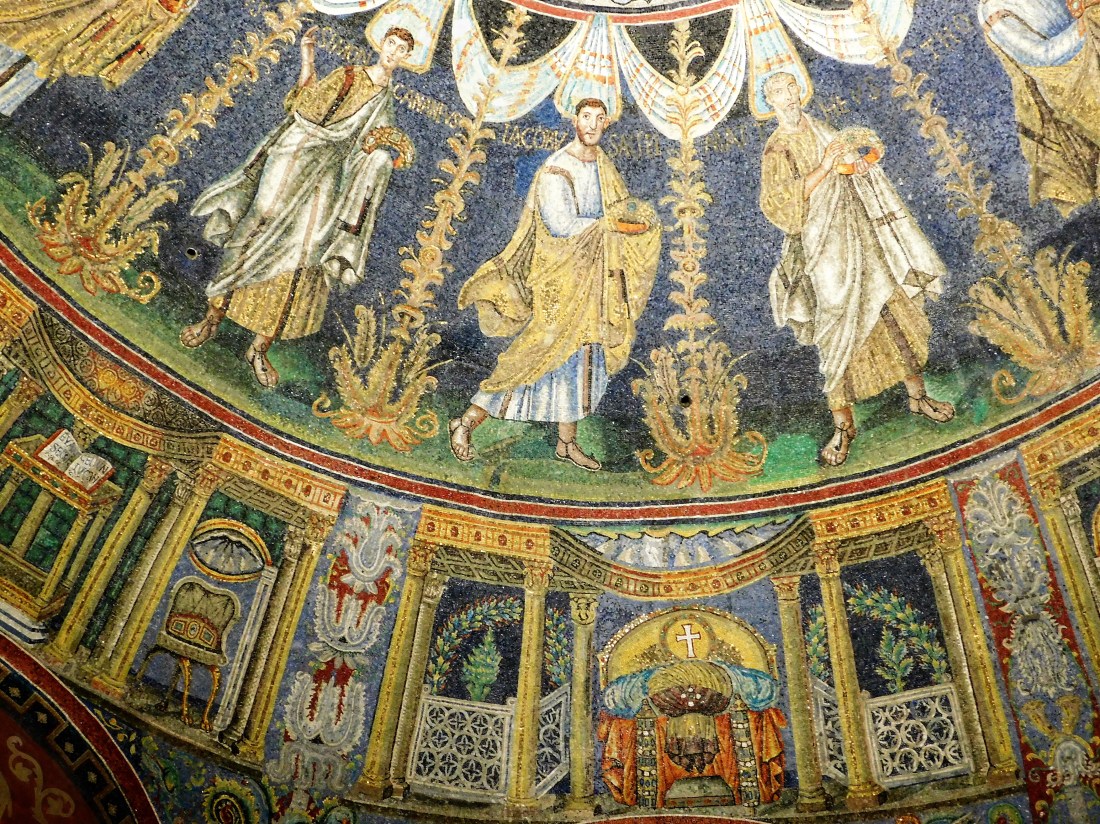
From there, we moved on to the Neonian Baptistery, one of the most ancient monuments in the city, which dates from the beginning of the 5th century. Smaller than San Vitale’s Basilica, the inside of this building is adorned with mosaics of Hellenic-Roman influence. At the center of the dome, a big medallion frames the Baptism of Christ, depicted as a young man immersed to the hips in the sheer waters of the river Jordan. This is one of the oldest mosaic scenes of the Baptism of Christ housed inside a monumental building. The images of the twelve Apostles, divided into two groups led by Saint Peter and Paul, revolve around the central medallion, standing out against a blue background.

After another stop for a delicious lunch of bruschetta, ravioli and wine at a tucked-away restaurant, we wandered the quiet streets of the city until we found the tomb of the legendary Italian poet, Dante Alighieri. Unfortunately, we arrived when the tomb was closed but, it is said that you can step inside the small, simple marble structure which holds Dante’s bones, and is one of Ravenna’s most treasured relics.

When you visit Ravenna, you could easily spend a good day or two walking through all of the Basilicas and Museums. Plus, that gives you plenty of time to take in the charming atmosphere that so many have easily fallen in love with. And if you find yourself with some extra time on your hands while you’re in the area, I’d recommend checking out the beaches, or taking a trip to the microstate of San Marino (about an hour’s drive to the South), or the resort town of Cesenatico (34 minutes Southeast of the city). No matter what you do around this medieval masterpiece of a city, it’ll be well worth it!


The Rolling Hills of Tuscany: Montalcino

At seven in the morning, I trudged, half-asleep, to the Piazza Trilussa to board a coach bus that would carry me through the Tuscan hills for the next few hours.

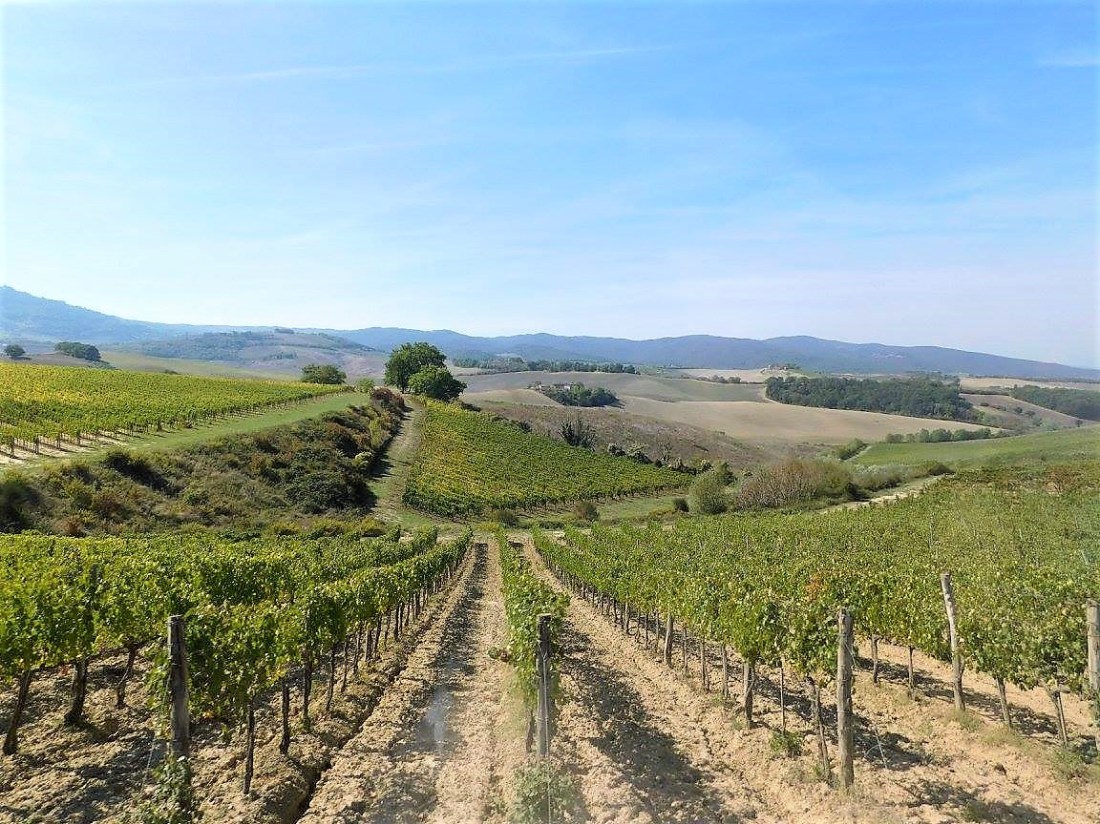
Normally, I would groan and wail in despair at the thought of doing anything before brunch, but I guess this was one of those few exceptions. But, seeing the famous, picturesque rolling hills of Tuscany seems like it would be worth it. And I was not disappointed. When I was on my way to a small medieval town tucked away in the hills, Rome has caught in a three-month drought (but don’t worry, it’s long since over now!) so not everything was as green as you see it in the movies. Nonetheless, it was still just as spectacular! As we drove down the highway, we were surrounded by tall hills and wide-open fields. Cypress trees stood tall and in lines between the fields, stretching up toward the clear light blue sky and lining the long dirt roads that led to quaint villas.

True to the pictures you see in travel books or in movies, they stand separate from one another, their privacy protected by more cypress trees, shrubs and little gardens. Some are made of a beautiful dark stone and others a charming terra-cotta orange and tan with small cracks and fading from age. I couldn’t help but to swoon – it’s like you’re standing in a postcard.

Taking a deep breath out in the countryside, is an inspirational moment on its own, as the air is so crisp and fresh. It has a way of putting you at ease and make you feel tranquil. Since this was the first time I had left Rome in a month, I became so accustomed to the noise and tight spots of the Eternal City. But out there, even the birds were quiet. All you could hear was the soft rustle of the trees when a breeze washed over you and you could find a sense of peace again.

Conceivably, some of my favorite parts of the trip were driving along the hill tops. You could look out over rolling hills and fields, which in late August are slowly fading from green to light brown, and they seemed to go on for miles before mountains interrupted them.

Words and pictures can’t do it justice….. it is something you must experience for yourself.

Our first stop was at Caparzo Srl Società Agricola, a winery tucked at the end of a long dirt road. There, I tried out the different wines they offered us, even thou I am not a drinker, and toured the vineyard. It was Italian wine in Tuscany after all. But the thing about Italian “wine tasting” is that you aren’t sampling a fingers-worth of wine, like in the States, instead, you’re drinking a whole glass of one wine and then a glass of another. Unfortunately, I could only bring myself to finish one glass. And it wasn’t even a full glass, it was hardly even half a glass. But, in my defense, it was a big wine glass to begin with, and I’m a terrible lightweight. Getting buzzed on my first trip to Tuscany was not in the itinerary. I still had a lot to see and do.

At the winery, the Vintner let us try their Vermentino IGT Doga delle Clavule (a white wine), Rosso di Montalcino D.O.C Caparzo (a red wine), Super Tuscan Caparzo (a darker red wine), and their Moscadello Vendemmia Tardiva (a dessert wine). And, because I’m me, all of those fancy, unnecessarily long names went into one ear and out the other. Why can’t they just call red wine as red wine and white wine as white wine? By the time they finished saying the name on the bottle, I was already buzzed. It’s ridiculous. But it was all very good. The first red wine they offered was bold in taste and I couldn’t finish it, and since I didn’t finish that glass, I never got to try the darker red. But others with me said it was even stronger than the first. So that was a no-go for me. The first white was good and, since it was lighter than the red, I had an easier time drinking it. Lastly, the dessert wine was thick but still smooth, and had a fruitier taste to it which I enjoyed more.

We were given a light lunch amidst the tastings. We enjoyed cold cuts of prosciutto and salami, a selection of cheeses, bread with olive oil and bruschetta, which was all excellent. Then for dessert we were served biscotti and moist bite-sized cakes, one with a blueberry jam on top and another with a honey-lemon jam.

Next, we travelled to the town of Montalcino. The tour guide we met upon arrival was fantastic; a middle-aged woman, who was very knowledgeable about the town and regions history. I mentally praised her for her talents. Until, she got to the story of Romulus and Remus… There was a little statue of the She-wolf and the infant twins in the center of the main piazza, and she briefly went through the story despite my vehement nods that we understood it, being classical majors. The tables turned on my opinion of her when she made a major slip-up. She stated that Romulus killed Remus because Remus “made fun” of the boundary Romulus had created around his soon-to-be city. That is incorrect! The boundary was a sacred boundary, a sort of promise to the gods and, in turn, a sort of blessing. Remus recklessly jumped over the sacred boundary to mock his brother and his action was, in a way, a slap to the face of the gods. Romulus didn’t want his brother to be punished by the gods, so he took it upon himself to kill his own brother, as a way to show mercy. After which, Romulus mourned as he gave his slain brother a proper burial.

I’m ready for my Ph.D. now….

Montalcino, a town built into the side of a hill, overlooking a valley and protected by walls, only has a population of about six thousand. It was a town of merchants and pilgrims that grew over the centuries. Now, it’s a quiet little place that specializes in wine (too much wine in one day for me) and cute little souvenirs for those passing through. Because some of the town slants down the side of the hill, the streets are very steep and narrow with stairs as alleyways connecting the streets together. Life-threatening to clumsy people like me, but charming all the same.

The town center consists of small shops, cafes and churches that surrounded a tall, brick clock tower. The streets and sidewalks were very clean, just like the orange, white, and tan stones and houses. After staying in Rome, I had nearly forgotten that not all buildings were required to have graffiti and street art on them. Another good thing about going from Rome to Montalcino was that, for once, I didn’t have to worry about the possibility of getting ran over. There were cars in Montalcino, but I never saw them move.

Another bonus was of course, the view. Practically everywhere you went in Montalcino, you could peer down streets and between buildings and see more fields and rolling hills stretching out under the blue sky. Which is one of the reasons why I highly recommend stopping by there, if you ever happen to be in that region. It may not be a large town with a million things to do and see, but if you wanted to take a break from traveling around, I would suggest taking some time in Montalcino, to get lunch or to pick up small gifts. And taking pictures is always a great idea!

So, all in all, this little Medieval town is definitely worth a day trip!