
Walking through quiet, empty streets in Trastevere at five o’clock on a Saturday morning was never something I desperately wanted to do, but now I can say that I’ve done it.
My friends, Hannah, Emmie and I meandered through the narrow streets toward Rome’s train station with no breakfast and very little sleep. Today adventure awaits. We had planned a quick daytrip to a small-town East of Bologna, called Ravenna. Nestled just an hour from the coast, in the province of Emilia-Romagna, this town of almost 160,000 people is best known for its art – namely its extensive mosaics – and its long history. The city was once the capital of the Western Roman Empire from 402 until its collapse in 476 AD. Today, Ravenna is a world heritage site for its famous early Christian monuments.
After our nearly four-hour train ride through the mountains and countryside from Rome to Ravenna, we finally made it! The moment you exit the train station in Ravenna, it’s easy to pick up on the quiet, small town feel of this city. It doesn’t feel crowded when compared to Rome which gives you a nice break from any hustle and bustle. As a bonus, the city is about a fifteen-minute car ride from the coast which is said to have excellent beaches and resorts. Unfortunately, we didn’t get to go there, on this trip. Instead, our group stopped at a friendly and cozy café for a light breakfast, then we headed off to the first attraction – the Basilica of San Vitale. Built in 547 CE, the Basilica is considered one of the most important examples of early Christian Byzantine art and architecture in Europe, and it is also one of the eight structures in Ravenna listed as a UNESCO World Heritage site.
When you first enter the building, you’re immediately swept up by the width and towering height of the space, the beautiful mosaics and the stunning baroque fresco on the dome overhead. But the most famous aspect of the Basilica is, without a doubt, the apse. Made from magnificent Byzantine mosaics of gold and green, the Twelve Apostles and two other saints – who are probably Gervasius and Protasius, sons of St. Vitalus – decorate the tall arch. Beyond that, the apse mosaic depicts Christ the Redeemer sitting on the sphere of the world, flanked by San Vitale who is being handed a martyr’s crown, two angels, and Bishop Ecclesius, who founded the church.
The Basilica of San Vitale is a site to behold and a must-see attraction when in Ravenna.
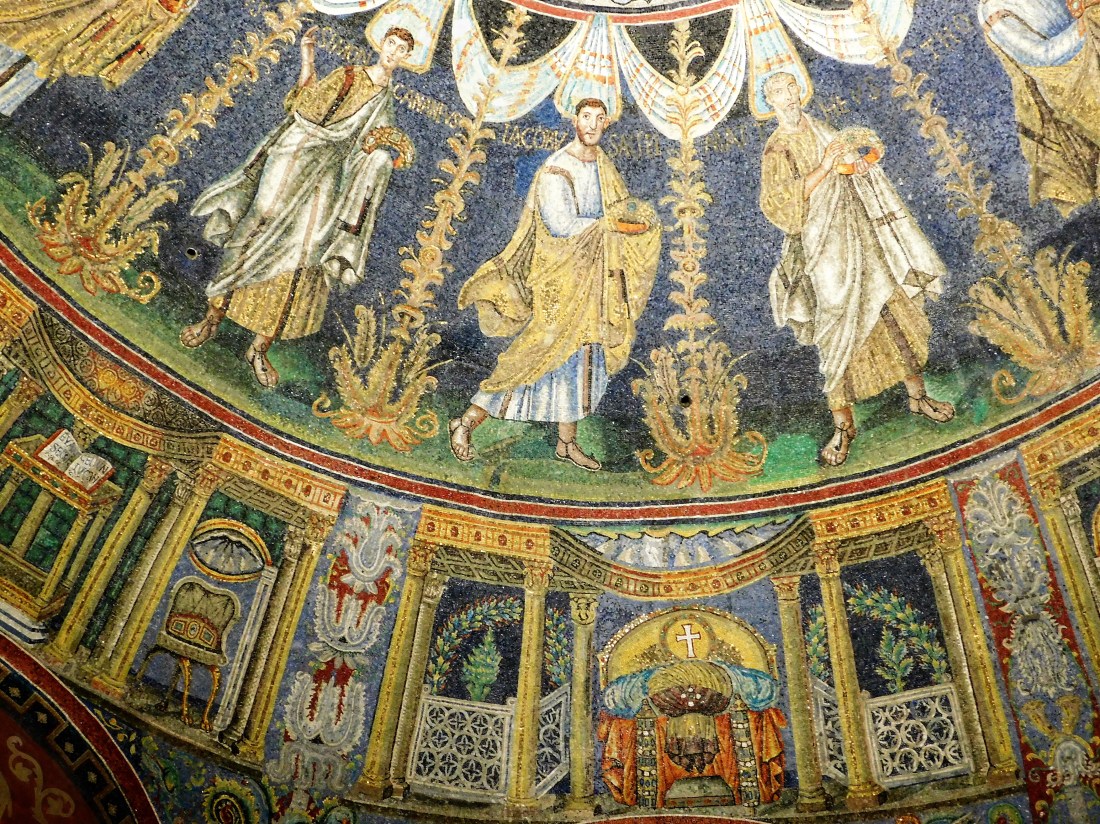
From there, we moved on to the Neonian Baptistery, one of the most ancient monuments in the city, which dates from the beginning of the 5th century. Smaller than San Vitale’s Basilica, the inside of this building is adorned with mosaics of Hellenic-Roman influence. At the center of the dome, a big medallion frames the Baptism of Christ, depicted as a young man immersed to the hips in the sheer waters of the river Jordan. This is one of the oldest mosaic scenes of the Baptism of Christ housed inside a monumental building. The images of the twelve Apostles, divided into two groups led by Saint Peter and Paul, revolve around the central medallion, standing out against a blue background.
After another stop for a delicious lunch of bruschetta, ravioli and wine at a tucked-away restaurant, we wandered the quiet streets of the city until we found the tomb of the legendary Italian poet, Dante Alighieri. Unfortunately, we arrived when the tomb was closed but, it is said that you can step inside the small, simple marble structure which holds Dante’s bones, and is one of Ravenna’s most treasured relics.
When you visit Ravenna, you could easily spend a good day or two walking through all of the Basilicas and Museums. Plus, that gives you plenty of time to take in the charming atmosphere that so many have easily fallen in love with. And if you find yourself with some extra time on your hands while you’re in the area, I’d recommend checking out the beaches, or taking a trip to the microstate of San Marino (about an hour’s drive to the South), or the resort town of Cesenatico (34 minutes Southeast of the city). No matter what you do around this medieval masterpiece of a city, it’ll be well worth it!


 Wanderlost Notes